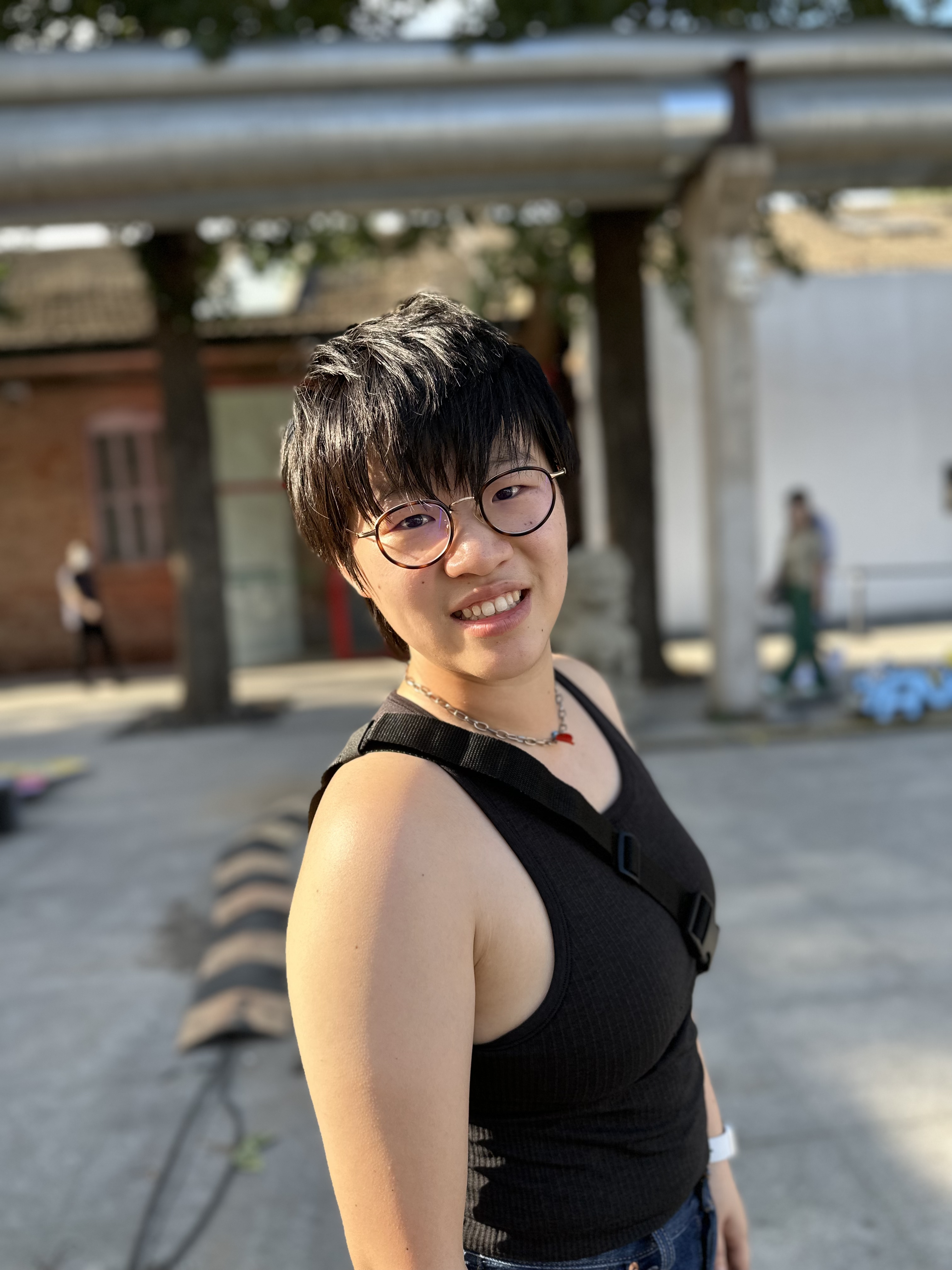
🌈Hello, I’m Jo-Ku Cheng!
🧑🎓 I am a first-year PhD student in Natural Language Processing (NLP) group at the University of Sheffield, under the supervision of Dr. Marco Valentino and Prof. Nikolaos Aletras.
I obtained my master’s degree in Applied Mathematics from the School of Mathematical Sciences, Peking University, where I was supervised by Prof. Jinwen Ma.
🧐 My research interests include integrating neural and symbolic approaches within language models to enhance their reasoning capabilities, controllability, and interpretability.
😄 I am from Taichung, Taiwan and grew up in Beijing.
News
- 📝 August 2026 — Our paper “Logic Before Language” has been out on arXiv! See here for the preprint.
- 🇩🇪 June 2026 — Attended the Neuro+Symbolic AI Summer School in Leipzig, Germany.
- 🏴 February 2026 — Started my PhD in Computer Science at the University of Sheffield.
- 🇨🇳 November 2025 — Attended EMNLP 2025 in Suzhou, China.
- 🇮🇪 October 2025 — Attended ACM Multimedia 2025 in Dublin, Ireland.
- 📝 August 2025 — Our paper Beyond Binary Preferences: Semi-Online Label-Free GRACE-KTO with Group-Wise Adaptive Calibration for High-Quality Long-Text Generation was accepted to Findings of EMNLP 2025.
- 📝 July 2025 — Our paper GeoUni was accepted to ACM Multimedia 2025.
- 🇨🇳 May 2025 — Attended the ICASSP 2025 Satellite Event in Suzhou, China.
- 📝 December 2024 — Three papers were accepted to ICASSP 2025: Diagram Formalization Enhanced Multi-Modal Geometry Problem Solver, SwapTalk: Audio-Driven Talking Face Generation with One-Shot Customization in Latent Space, and Enhancing Large Language Models on Domain-Specific Tasks.